Te Araroa Stories: Stuff I Carried (and Stuff I Should’ve Left Behind) for 3000 km Long Journey
Well-packed gear is a crucial element for finishing the trail. You should have everything you need and nothing you don’t, because you’ll feel every extra gram. At the beginning of the trail, I saw many people with heavy backpacks, but as I went further, I saw fewer of them — and more hikers who were efficiently packed. My base weight (the weight without water and food) was somewhere between 7 and 8 kg. You can definitely go below that (I met a few people with a base weight of just 4 kg!), but you need to decide how much money you’re willing to invest in your gear and what you’re willing to give up.
We can probably agree that carrying a camping chair for evening comfort isn’t very practical and you don’t need to bring that. On the other hand, having a second set of dry clothes in case you have to walk in the rain is, in my opinion, important. Imagine walking all day in the rain, being cold, and having no dry clothes to change into for the night. A base weight around 7 kg is a good number to aim for — it doesn’t require huge trade-offs in your gear if you pack smart, but it’s still light enough not to bother you too much over a few months.
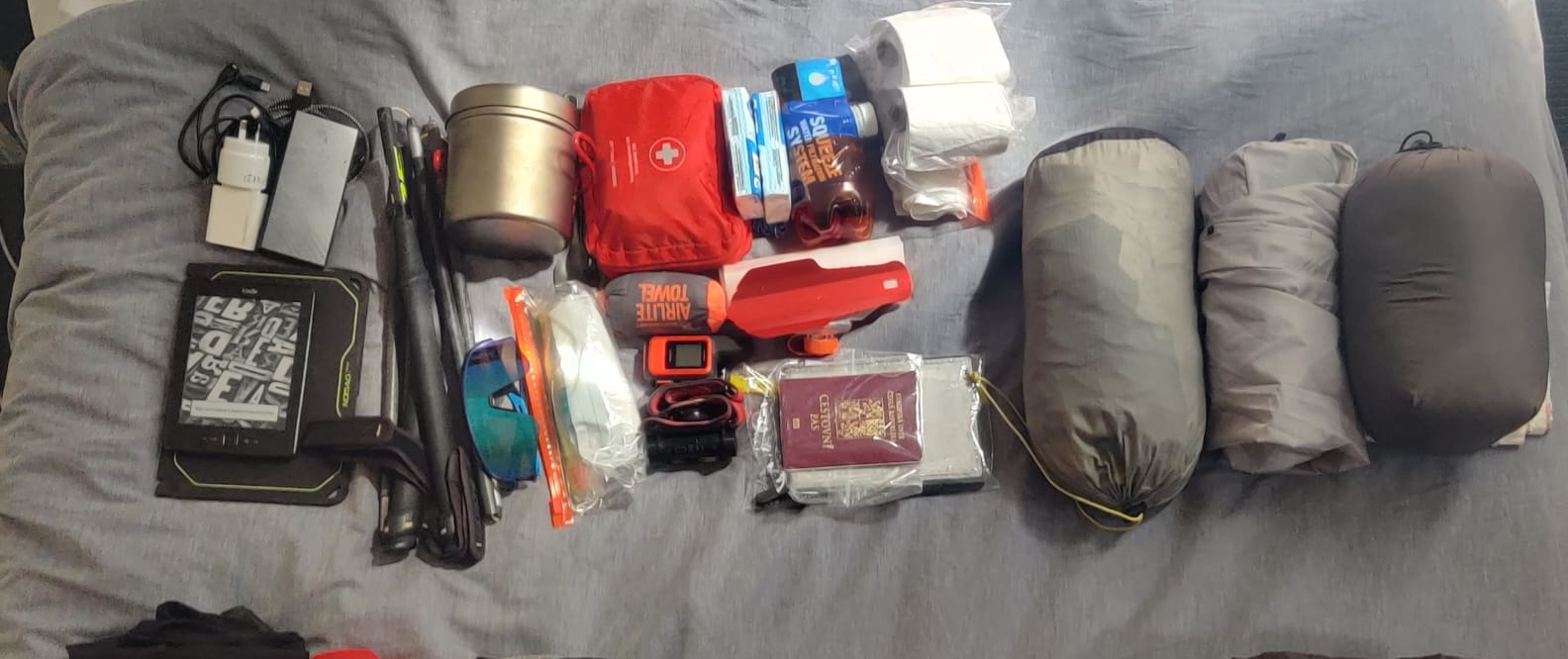
I don’t consider myself an expert on gear or packing. I’m aware that many things could be improved, but I didn’t carry any useless items, and I think I had everything I needed to survive four months in the wilderness of New Zealand. I’m posting my gear list below — don’t take it as advice, but rather as inspiration in case you need some.
Happy trails!
My gear list for the Te Araroa trail
Backpacks and bags
- backpack (Hyperlite - 55 liters, tall version - this backpack is rainproof!)
- dry bags (to organize my stuff inside the backpack and make sure everything stays dry even if some water gets inside the backpack)
- waterproof pocket for the phone (you never know when you might fall into a river during a river crossing, or get caught in heavy rain)
Hygiene
- toothbrush
- toothpaste
- sunscreen (I had to buy a few during the trail)
- Gillette (I didn’t shave, but it was useful in case I needed to use kinesio tape - body hair and tape don’t work well together)
- toilet paper
- poop shovel (to bury your poop and make sure animals don’t spread feces to water sources)
- little soap
- paper tissues
- small towel (very light Sea to Summit towel)
Clothes
- small puffy jacket (Patagonia)
- shoes (I had three pairs - the second and third were waiting for me on the trail)
- thin gloves
- Buff (can be used as a beanie or protection against the sun)
- rainproof jacket (three-layer PERTEX)
- rainproof pants
- shorts
- long running leggings
- Merino shirt with long sleeves (two)
- T-shirt with short sleeves (for most of the hiking)
- Merino underwear (two pairs - you wear one and can wash the other. Merino doesn’t smell and keeps you warm even if it gets wet from rain or river crossings.)
- socks (three pairs at the beginning, but I had to buy a few more as they developed holes)
- trail cap with 🚀 (my secret weapon, source of energy and protection against the sun)
Electronics
- headlamp
- red light (I bought it in the second half of the trail when there was a lot of road walking, and I sometimes had to walk in low visibility or in the dark)
- power banks (I had two, 10,000 mAh and 20,000 mAh, just to have one for my watch and the other for the phone. Keeping the watch charged was important for navigation; the phone was mostly for photos.)
- solar panel (Goal Zero - I wouldn’t bring it next time for this trail. New Zealand is wild but I always had opportunities to recharge power banks almost every week.)
- phone
- GPS watch (Garmin Forerunner 945 - I used it for tracking and navigation)
- various charging cables
- power adaptor with two USB sockets (very useful when you are at a hostel and need to recharge multiple devices)
- headphones (it’s sometimes nice to listen to some music)
- satellite phone (Garmin inReach Mini - a must in case of potential rescue, because New Zealand has poor mobile network coverage)
- Kindle (I didn’t use it much but it’s good to have the option of doing something other than hiking all day)
- power socket adaptor (New Zealand to European)
Sleeping
- tarp (Six Moon Designs - Deschutes)
- Tyvek (as a floor for the tarp)
- sleeping mat (Therm-a-Rest NeoAir XLite - regular length, wide version)
- sleeping bag (Cumulus - comfort around 2°C)
Others
- diary (I kept a physical journal on the trail)
- pen
- first aid kit (plasters, activated charcoal and other basic medications, scissors, needles, thread)
- survival blanket
- hiking poles (also used as supports for the tarp)
- water bladder (2 liters)
- water squeeze filter (Sawyer)
- syringe for cleaning the water filter (there’s nothing worse than a clogged filter)
- water bottle (Nalgene 1.5 l)
- sunglasses
- knife
- cooker
- pot
- gas bottle for cooking (you can’t take it on a plane, so I bought one just before starting the trail)
- spoon
- lighter
- ziplock bags (can be useful for various things - for example, storing food)
- passport
- thin cord (for hanging wet clothes or minor repairs)
- trash bag (makes it easier to keep trash in one place)
If you want to read about the beginning of my journey on the trail, continue reading.